Engineering a Safer Crash Guard
TL;DR
My bike crashed at 25 km/h and the crash guard which was supposed to protect it - folded inward and killed the clutch instead.
I reverse-engineered the physics, ran the simulations, and redesigned it so it actually does its one job.
1. Context & The Incident
Crash guards are supposed to be sacrificial: take the hit, save the bike. Mine took the hit and then decided to also pinch the clutch cable, disengaging it by 30%. Helpful.
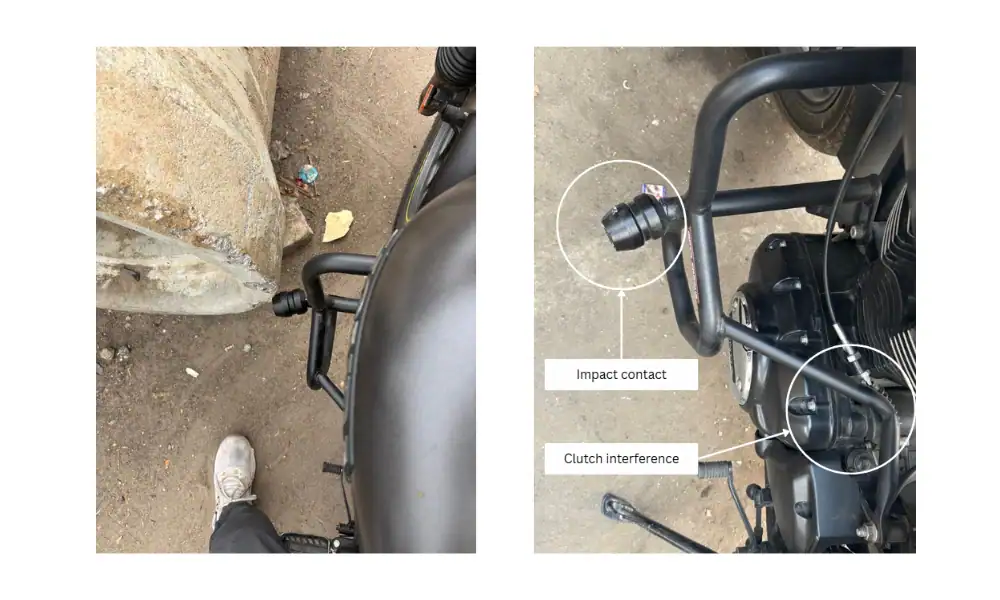
I managed to ride to a repair shop where the mechanic heated and pulled the bend back into place. But this raised a severe safety question: If a 25 km/h slide causes a functional failure of the controls, what happens at higher speeds?
2. Impact Physics & Load Calculations
To simulate this in CAD, I first needed to translate the real-world 25 km/h snag into a static force equivalent (kN) to use as a boundary condition for the FEA.
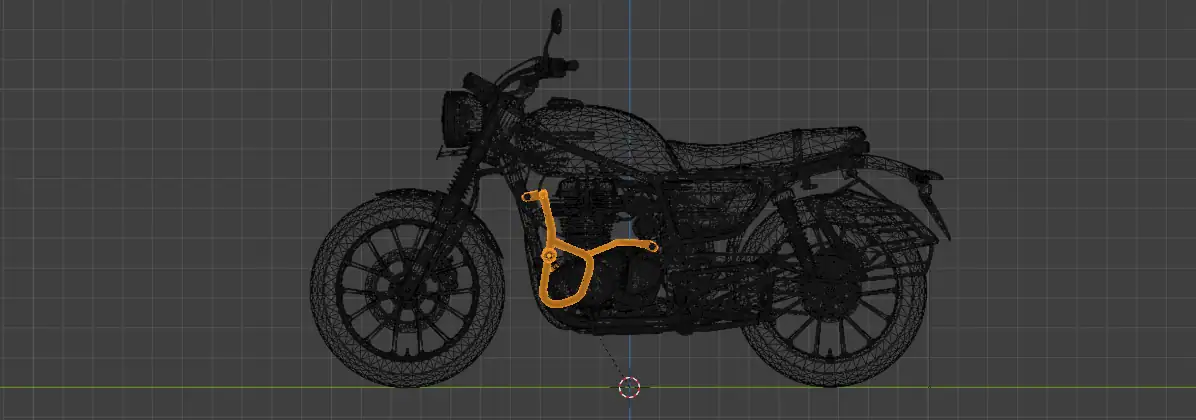
Assumptions & System Variables:
- Velocity (v): ~25 km/h = ~6.94 m/s
- Mass (m): Total effective mass (Bike 185 kg + Rider 65 kg) ~ 250 kg
- Stopping Distance (d): Estimated stopping distance during the rigid snag ~30 cm
Kinetic Energy Calculation: First, we determine the kinetic energy (EK) of the sliding bike just before the snag:
Theoretical Maximum Impact Force:
Using the Work-Energy principle ( W = F.d ), the absolute worst-case scenario (100% rigid, inelastic collision) yields:
Dissipation Factor:
In a real-world crash, some of the kinetic energy will be dissipated during the snag through overall friction, rider movement, chassis flex, etc. To account for these losses in the simulation, we factored out 25% of the theoretical load to account for this energy dissipation.
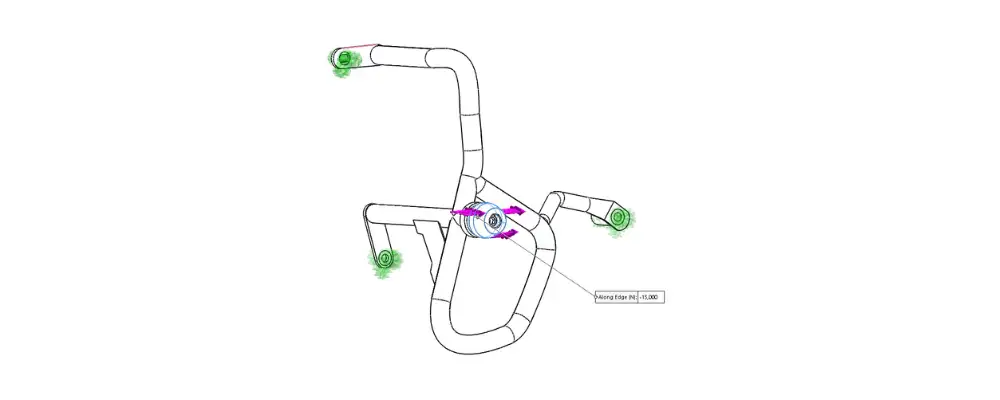
This establishes our testing baseline: a 25 km/h snag generates a realistic, effective crushing force of 15 kN.
3. Baseline Simulation: Original Design
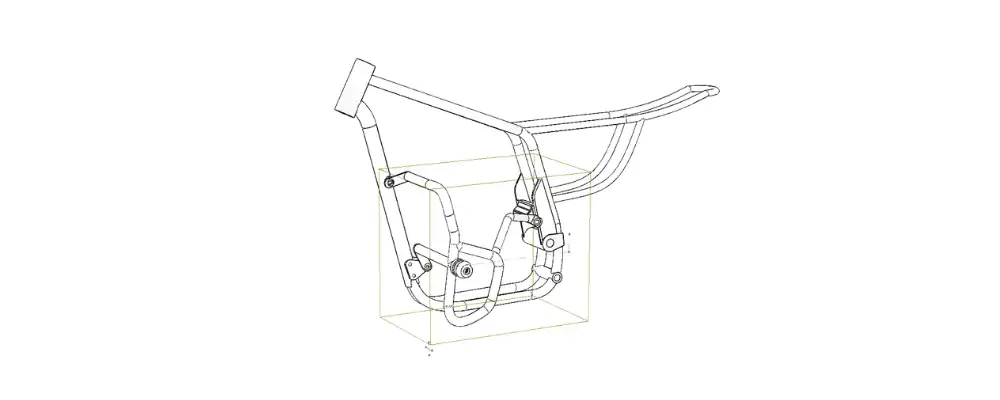
With the 15 kN target load established, I set up a static structural study on the original crash guard geometry to see how it handled the force.
FEA Setup:
- Fixtures: Fixed geometry at the main chassis mounting points.
- Load: 15 kN applied at the slider tip, perpendicular to the bend axis.
Results: The simulation perfectly mirrored my real-world crash. Under the realistic 15 kN load, the original design experienced a maximum inward displacement of 43 mm.
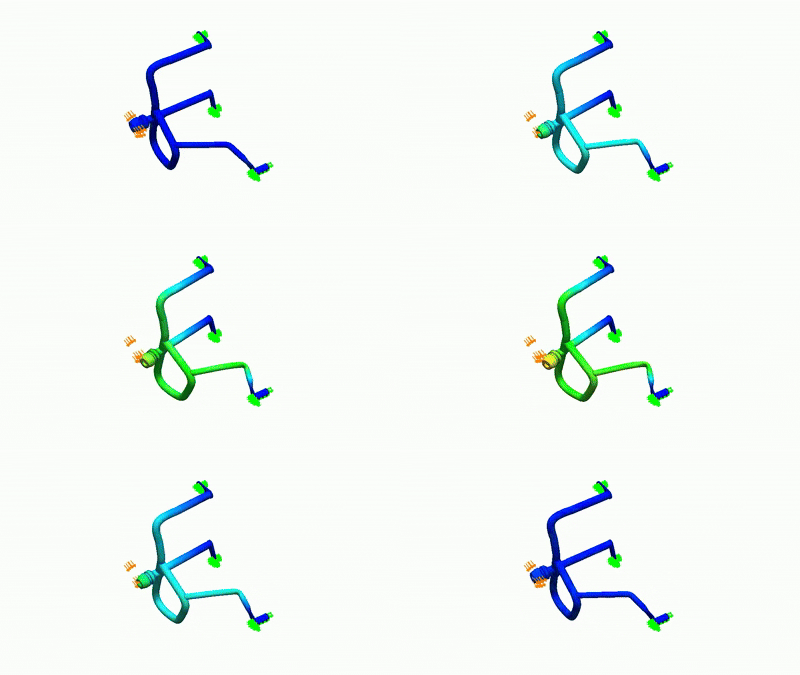
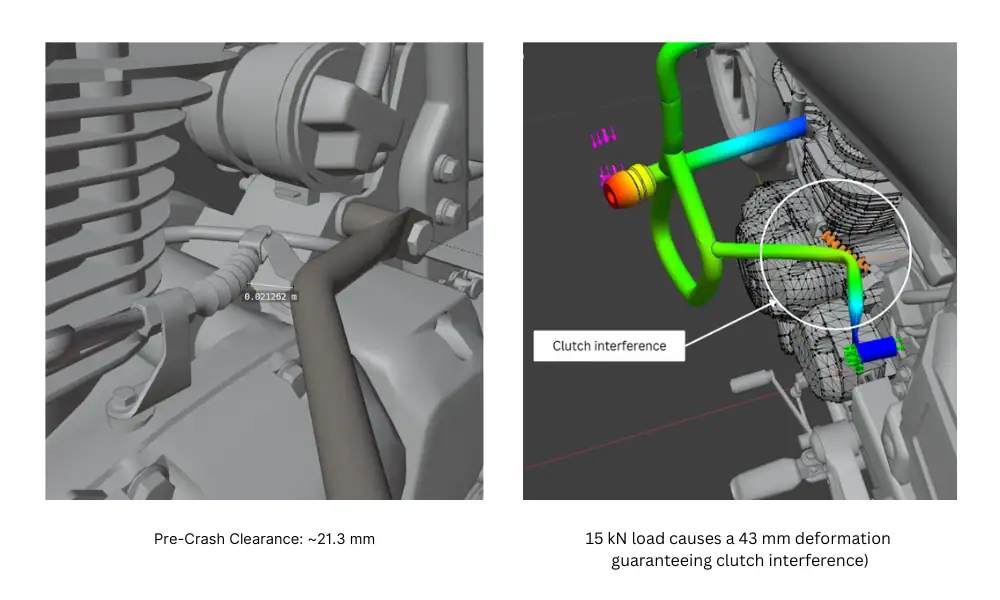
Because the clearance between the guard and the clutch cable is roughly 21 mm, this mathematically (also visually) proves the interference.
4. Validation Simulation: Adjusted Design
The updated CAD model was subjected to the exact same boundary conditions to see if the new geometry could handle the 15 kN real-world load, and how much further it could go.
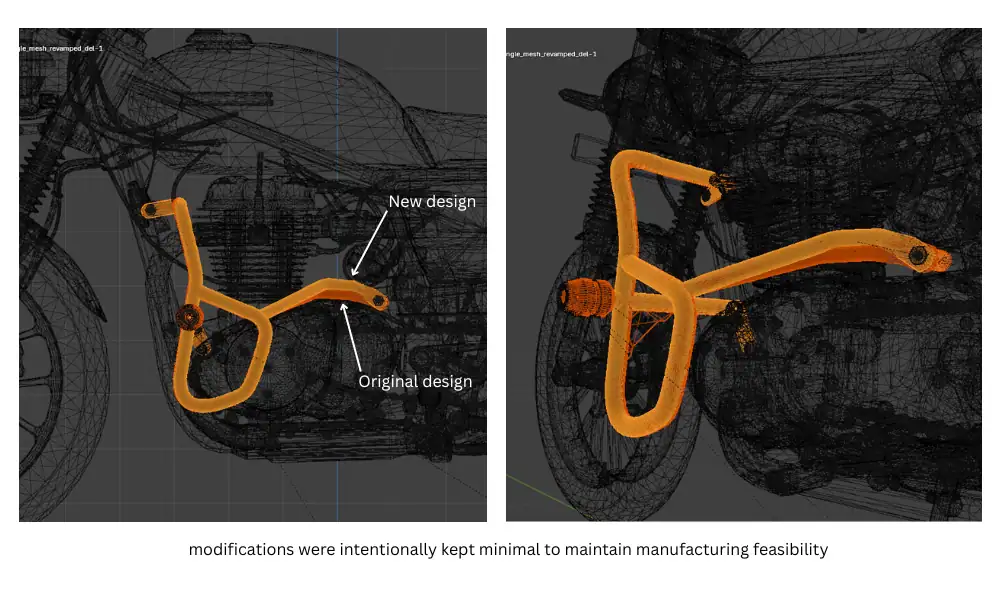
Results: The improvement was massive. Under the target 15 kN load, the inward deformation was reduced to just 20.1 mm (perhaps we can go easy on the bend angle reduction of the guard). More importantly, the deformation path was entirely redirected. It completely clears the clutch assembly.
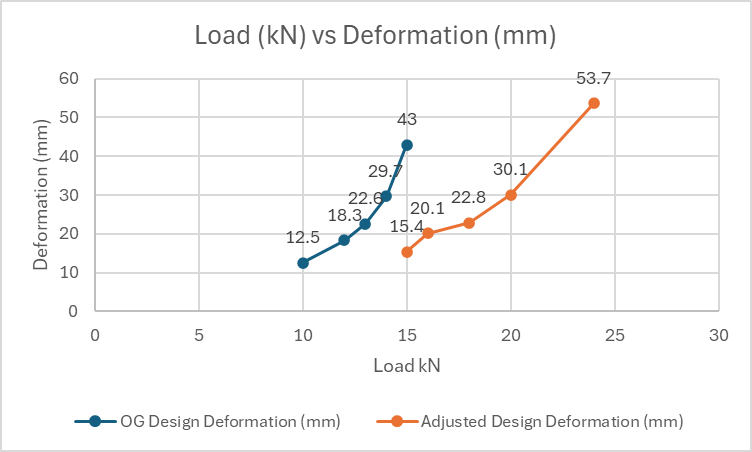
Data Breakdown & Safety Margins: As seen in the graph above, the behavioral divergence between the two designs is clear:
- Original Design (Blue): Rapid structural yield, hitting the 40mm failure threshold early at ~14.5 kN. It is fundamentally incapable of surviving a 25 km/h snag without causing secondary damage.
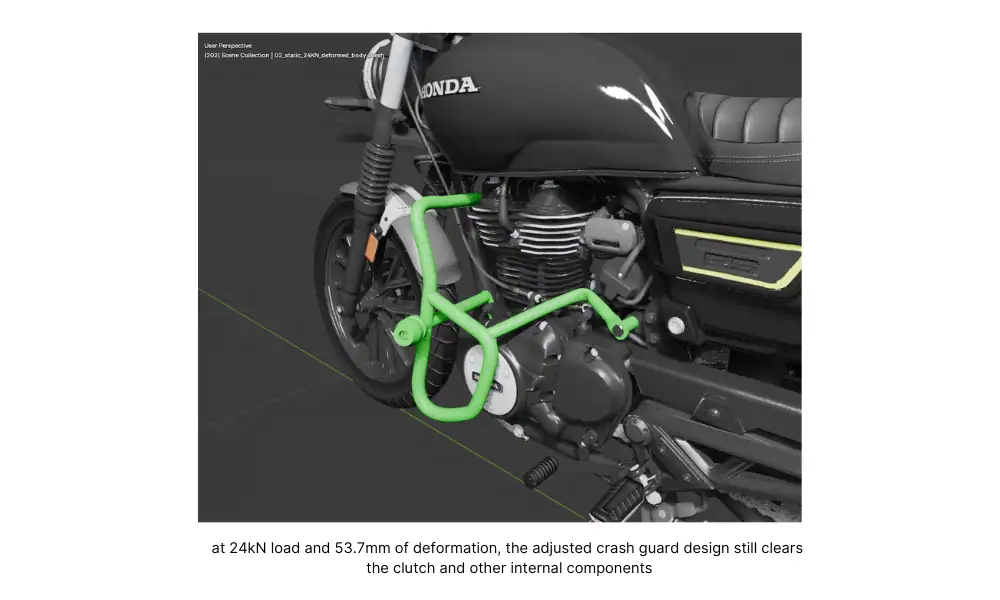
- Adjusted Design (Orange): At the 15 kN real-world target, it only yields 15.4 mm (well within the safe zone). Furthermore, it provides a massive Factor of Safety (FoS), it can withstand up to a 20+ kN theoretical maximum load before approaching the same failure thresholds as the original guard.
5. Conclusion & Takeaways
Turns out fixing a dangerous design flaw just takes some physics, an FEA tool, and the motivation of having lived through the failure.
Aesthetics and thick steel don't count for much if no one bothered to simulate what happens when things go wrong.
6. Future Scope
While this static study was enough to reveal and fix a practical flaw, a more rigorous analysis could include:
- Dynamic / Explicit Crash Simulation: Utilizing realistic crash boundary conditions instead of static loads.
- Full Chassis Coupling: Analyzing how the 20+ kN forces are transferred to the engine mounts and frame welds.
- Material Fatigue Analysis: Assessing the long-term vibration effects on the new geometry.
Thanks for reading. If this helps you catch a design flaw before it becomes a crash, or just think differently about how things break, then it's been worth sharing.